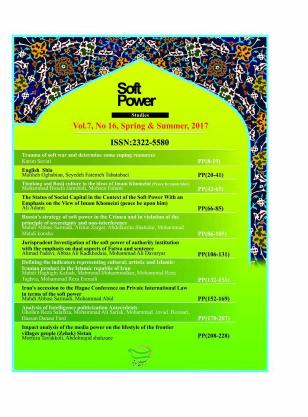
Corona management and increasing the soft power of the Islamic Republic of Iran

Document Type : Original Article

Authors

1 Master of Political Science, Payame Noor University, Quchan, Quchan, Iran.

2 Assistant Professor, Department of Political Science, Payame Noor University, Tehran, Iran.

Abstract
In different societies, different models of crisis management are used to deal with the crisis, which is completely influenced by the political system that governs these societies. With the widespread spread of the corona virus, different perspectives on politics and the ability of different political systems to face new crises such as the corona have been proposed and the corona era has become a suitable benchmark for measuring the efficiency of governments and governance models; In a way, the success of governments in controlling that soft power has increased them and, conversely, their failure to control this virus has paved the way for the decline of governments' soft power. The main question that this article examines and evaluates is how Corona management can lead to an increase in soft power in the Islamic Republic of Iran? The present article is an analytical descriptive and will examine this question using the library method. To answer this question, this study examines the experience of successful Asian countries in managing the Corona crisis, including China and South Korea, to explore the key elements of their success. Studies show that the pillar of authoritative management and leadership and the existence of a unified strategy in the shadow of taking advantage of the achievements in the field of technology has helped these countries to improve their position in the field of soft power. Accordingly, this study focused on this specific issue and provided the requirements for better management of this crisis.

Keywords


  • اخوان کاظمی، مسعود (1387). «ورزش و سیاست»، فصلنامه المپیک، شماره 2.
  • آل کجباف، حسین (1392). «مفهوم و جایگاه حق بر سلامت در اسناد بین المللی حقوق بشر»، فصلنامه حقوق پزشکی، دوره 7، شماره 24، صص 139-170.
  • انوری، حسن (1382). فرهنگ فشرده سخن، تهران: نشر سخن.
  • جاوید، احسان؛ نیاورانی، صابر، (1392). «قلمرو حق سلامتی در نظام بین الملل حقوق بشر»، فصلنامه پژوهش حقوق عمومی، دوره 15، شماره 41، صص 47-70.
  • شجاع، جواد (1387). «تحقیق و توسعه فناوری نانو از نگاه حق بر سلامتی»، تهران، مجله‌ی پژوهش‌های حقوقی، سال هفتم، شماره 14.
  • غرایاق‌ زنـدی، داوود (1387). «چـشم‌انداز امنیت انسانی در خاورمیانه سده بـیست و یـکم»، فصلنامه‌ مطالعات راهبردی، شماره 41، صص 573-600.
  • گرجی، علی اکبر (۱۳۸۳). «مبنا و مفهوم حقوق بنیادین»، نشریه حقوق اساسی، شماره 2، صص 8-26
  • محرابی، ناهید (1393). «نقش کاربردی ابزارهای فناوری ارتباطات و اطلاعات در مدیریت بحران»، مجله پیراپزشکی، سال 9، ش 1، صص 48-53
  • مرکز توانمندسازی حاکمیت و جامعه جهاد دانشگاهی، توانمندسازی حاکمیت برای مقابله با کووید-19، (iran-bssc.ir)
  • مرکز بررسی‌های استراتژیک ریاست جمهوری، 12 دی 1399، ایران چگونه از آی.سی.تی در مدیریت کرونا بهره گرفت؟،  https://coronomy.ir/detail/1283
  • مرکز بررسی‌های استراتژیک (1399)، الگوهای حکمرانی در مدیریت کرونا، توصیه‌هایی برای ایران،

https://coronomy.ir/detail/1205

  • Attias, Shay (13 April 2020), Asian Soft Power Grows in the Corona Virus era
  • Bagheri Lankarani, Kamran; Alavian Seyed Moyed; Peymani Payam (2013), “Health in the Islamic Republic of Iran, challenges and progresses”, Med J Islam Repub Iran; 27(1), pp.42-49
  • Dams, Ties; Martin, Xiaoxue; Kranenburg, Vera (2021), “China’s Soft Power in Europe”, European Think-tank Network on China, https://www.ifri.org/en/publications/publications-ifri/ouvrages-ifri/chinas-soft-power-europe-falling-hard-times
  • Cho, Seo-Young; Ballbach, Eric; Claus-Kim, Daniela; Kim, Gyung Hyun (2020), South Korea's Soft Power in the Era of the Covid-19 Pandemic -An Analysis of the Expert Survey in Europe, Seoul Journal of Economics, Vol.33, N. 4, pp 601-626
  • Human Security center (2006), “Human Security Report 2005”, University of British Colombia Canada, 2006.
  • Kickbusch I, Gleicher D (2012), Governance for health in the 21st century, World Health Organization.
  • Klingebiel, Stephan & Torres, Liv (2020), Republic of Korea and Covid-19: Gleaning Governance Lessons from a Uniqe Approach, UNDP, https://www.undp.org/content/seoul_policy_center/en/home/library/republic-of-korea-and-covid-19--gleaning-governance-lessons-from.html
  • Moghaddam AV, Damari B, Alikhani S, Salarianzedeh MH, Rostamigooran N, Delavari A, Larijani B (2013), “Health in the 5th 5-years Development Plan of Iran: main challenges, general policies and strategies”, Iran J Public Health, No.42, pp.42-49
  • Nye, Joseph s. (2005), Soft Power: the Means to success in world politics, New York: public Affairs.
  • Roudolf, Moritz (2021), China’s Health Diplomacy during Covid-19, German Institute for International Security and Affairs,
  • Sharp Gene (1973c), The Politics of Nonviolent Action:The Dynamics of Nonviolent Action, Boston: Extending Horizons Books
  • Takemi, Keizo; Jimba Masamine and others (2008), Global Health as a Human Security Challenge, Background Paper for the Trilateral Commission 2008, Annual Meeting, Task force on ‘’Challenges in Global Health and Japan’s Contribution.
  • Vannarith, Chheang (18 May 2021), “How Covid-19 helped China boost its soft power mainland southeast”, South China Morning Post, , https://www.scmp.com/week-asia/opinion/article/3133852/how-covid-19-helped-china-boost-its-soft-power-mainland-southeast
  • Vannarith, Chheang (24 September 2020), “Fighting COVID-19: China’s Soft Power Opportunities in Mainland Southeast Asia”, The Southeast Asian Studies, https://www.iseas.edu.sg/posts/2021-66-fighting-covid-19-chinas-soft-power-opportunities-in-mainland-southeast-asia-by-chheang-vannarith/
  • WHO (2007), Everybody’s business: strengthening health systems to improve health outcomes: WHO’s framework for action. Geneva, Switzerland: World Health Organization, pp.1-56.
  • World Heath organization (2008), community emergency preparedness, WHO.