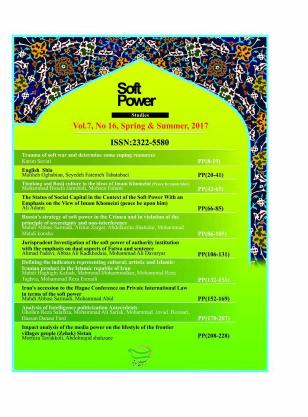
Document Type : Original Article
Author
Faculty member, Department of Islamic Political Thought, Research Institute of Imam Khomeini and Islamic Revolution
Keywords
Aliansab, Seyed Hossein; Salehi, Hassan and Mousavi Sharbiani, Seyed Jalal (2018). "Study of strategies to prevent the weakening of the soft power of the leadership of the Islamic Revolution based on Quranic teachings", Quarterly Journal of Islamic Revolution Research, Volume 7, Number 24, Spring, pp. 94-75. [in Persian]
Barnett M. and Duvall R. (2005). “Power in International Politics,” International Organization, vol. 59, Winter 2005, pp. 39-75.
Berenkoetter F. and Williams M. J. (ed.) (2007). Power in World Politics, Routledge; 1st Edition.
Clesse (eds.), Two Hegemonies: Britain 1846-1914 and the United States 1941-2001 (Aldershot: Ashgate Publishing, Ltd., 2002), pp. 165-182.
Dahl, Robert A. (1961). Who Governs? Democracy and Power in an American City, New Haven: Yale University Press.
Dahl, Robert A. )1957). “The Concept of Power.” Behavioral Sciences 2(3): 1957. pp. 201-215.
Dehshiri, Mohammad Reza (2018). "America's soft power decline; Reasons and Consequences ", Bi-Quarterly Journal of Soft Power Studies, Volume 8, Number 19, Fall and Winter, pp. 68-35. [in Persian]
Eftekhari, Asghar and Kamaleb, Ali (2015). "The Structure of Soft Power in Islamic Discourse", Bi-Quarterly Journal of Soft Power Studies, Volume 5, Number 12, 9-20. [in Persian]
Fattahi et al. (2018). "Analysis of the Soft Power Pattern in the Middle East: A Case Study of Saudi Arabia", Political Research in the Islamic World, Spring, No. 26, 2929-62. [in Persian]
Fawzi, Yahya, 2014, Imam Khomeini's Political Thought, 21st Edition, Tehran: Maaref. [in Persian]
Gilpin, Robert (2002). "The Rise of American Hegemony," in Patrick Karl O'Brien and Armand
Golshpajooh, Mahmoud Reza (2012). "The Role of Intelligence Organizations in Promoting the Soft Power of the Country", Quarterly Journal of Strategic Studies, Fifteenth Year, Summer, No. 2 (p. 56), 140-177. [in Persian]
Ismaili, Morteza (2017). "Indigenous Model of Soft Power of the Islamic Republic of Iran: A Model for Empowering Regional Actors", Quarterly Journal of Politics, Winter, Forty-seventh Volume, No. 4, 853-871. [in Persian]
Lukes, Steven. (2005). Power: A Radical View. Second Edition. Basingstoke: Palgrave MacMillan.
Mousavi Khomeini, Ruhollah (1999). Sahifa Imam, Tehran: Institute for Organizing and Publishing Imam's Works, vols. 3, 4, 5, 6, 7, 8, 14, 19, 20, 21. [in Persian]
Mousavi Khomeini, Seyyed Ruhollah (2002). Imam Khomeini's philosophical lectures, lectures by Abdul Ghani Ardabili, Tehran, Imam Khomeini Publishing House. [in Persian]
Nye, J. S. )2008(. “Public Diplomacy and Soft Power.” The ANNALS of the American Academy of Political and Social Science 616 (1) (March 1): 94–109. doi:10.1177/0002716207311699. http://dx.doi.org/10.1177/0002716207311699. Nye, J. S. 2008. “Public Diplomacy and Soft Power.” The ANNALS of the American Academy of Political and Social Science 616 (1) (March 1): 94–109. doi:10.1177/0002716207311699. http://dx.doi.org/10.1177/0002716207311699.
Nye, Joseph (2002), The Paradox of American Power: Why The World’s only Superpower Can’t Go it alone, New York: Oxford University Press.
Nye, Joseph (2002). The Paradox of American Power: Why The Worlds only Superpower Can’t Go It alone, New York: Oxford University Press.
Nye, Joseph S. (2004), Soft Power: The Means to Success in World Politics, New York: Public Affairs.
Nye, Joseph S. (2004). Soft Power: The Means to Success in World Politics, New York: Public Affairs.
Nye, Joseph S. Jr. (2002). The Paradox of American Power. Oxford: Oxford University Press.
Nye, Joseph S. Jr. (2010). “The Future of American Power: Dominance and Decline in Perspective.” Foreign Affairs 89(6): 2010. pp. 2-12.
Nye, Joseph S. Jr. (2011). The Future of Power. New York: Public Affairs.
Nye, Joseph S. Jr. “The Future of American Power: Dominance and Decline in ” Foreign Affairs 89(6): 2010. pp. 2-12.
Rafi, Hussein and Qarbi, Mohammad Javad (2011). "Soft Power Reading: A Case Study of Psychological Operations", Quarterly Journal of Political Studies, Summer, No. 12, 139-174. [in Persian]
Reveron, Derek S. (2010). Exporting Security: International Engagement, Security Cooperation, and the Changing Face of the U.S. Military, Washington, D.C.: Georgetown University Press.
Rezakhah, Alireza and Aghahseni, Alireza (2018). "US Soft Power Typology with an Emphasis on the American Exceptional Component", Bi-Quarterly Journal of Soft Power Studies, Volume 8, Number 19, Fall and Winter, pp. 98-69. [in Persian]
Soltaninejad, Ahmad; Jamshidi, Mohammad Hossein and Purdast, Zahra (2015). "Transformation of the concept of power in the light of new information and communication technology", Political Science, Volume 12, Number 23, Spring and Summer, 73-98. [in Persian]
Ulrich Beck (2005). Power in the Global Age: A New Global Political Economy (Malden, Mass.: Polity Press.
Wilson, Ernest J. III. “Hard Power, Soft Power, Smart Power.” American Academy of Political and Social Science Annals. 616: 2008. pp. 110-124.
Zolfaghari, Mehdi and Dashti, Farzaneh (2018). "Components and Capacities of Soft Power of the Islamic Republic of Iran in Cultural Diplomacy", Bi-Quarterly Journal of Soft Power Studies, Volume 8, Number 19, Autumn and Winter, pp. 154-127. [in Persian]